
The Working Capital Visibility Gap: Why CFOs Still Can’t See Their Own Cash

Real-time working capital dashboards help CFOs detect liquidity risks before quarter-end reporting.
Most finance leaders can tell you last quarter’s revenue to the decimal. Ask how much cash is trapped in their receivables, payables, and inventory right now, and the answer gets fuzzy. That gap between what the balance sheet eventually reports and what’s happening to cash today is the working capital visibility gap, and it’s quietly costing companies a fortune.
The scale is hard to ignore. PwC’s Working Capital Study 25/26 estimates €1.84 trillion of excess working capital that could be freed up for investment, based on analysis of more than 17,000 listed companies worldwide. The same study shows DSO is up 5.7% over the last decade, while DIO for the most cash-intensive sectors in Western markets is up 13.6%. This isn’t a problem of bad intentions. It’s a problem of seeing too late.
Why working capital visibility breaks down inside the enterprise
The root cause is structural. Deloitte’s Q1 2026 North American CFO Signals survey found that 46% of CFOs indicate that siloed departments / (or) autonomous business units are their biggest internal cost management hassle, with 39% of them identifying outdated tools and technology as a similar cost management frustration. That is how the working capital visibility gap forms: payables, receivables, and inventory are rarely seen as one live operating system. Each department runs on its own cycle, with its own definition of acceptable.
The result is fragmentation:
- Data lives in silos. SAP, Ariba, Coupa, and a dozen spreadsheets hardly communicate in real time.
- Reports reflect the past. By the time a month-end report flags a cash problem, the money has already left the bank.
- No single owner sees the whole picture. Each team optimizes its own metric while the cash conversion cycle quietly drifts.
The cost of seeing late, and the size of the prize
When visibility lags, problems compound. DSO creeps up as collections slow, DPO gets squeezed by uncoordinated early-payment programs, and inventory accumulates as teams hedge against uncertainty.
The upside of closing the gap is just as concrete. KPMG’s March 2026 Australian working capital trends analysis of 500+ public companies found median FY25 CCC at 62 days, with DSO at 46 days, DIO at 68 days, and DPO at 52 days. McKinsey’s April 2026 CFO Pulse Survey also found that nearly two-thirds of CFO respondents are increasing cash and liquidity buffers, while 22% want real-time intelligence and risk monitoring. Liquidity is no longer a back-office measure. It is becoming a board-level execution lever.
The message is consistent. Better Working Capital Management isn’t about squeezing harder. It’s about seeing clearly enough to act early.
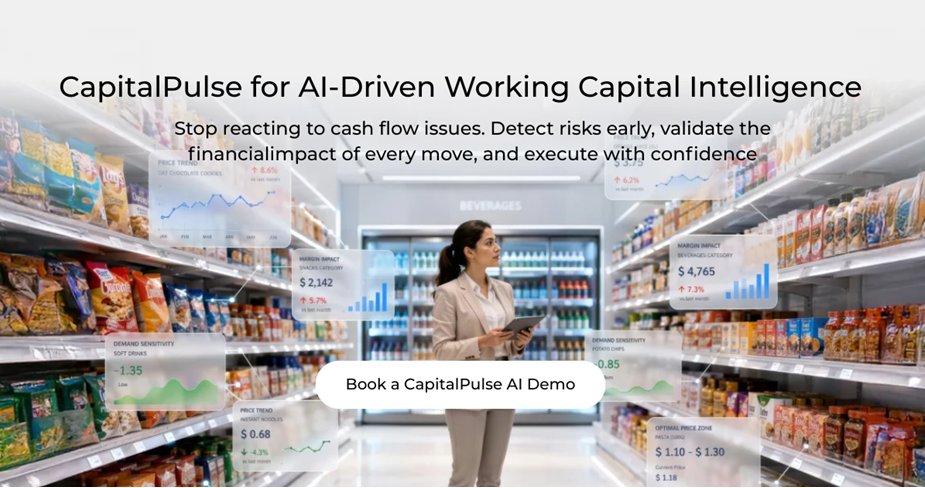
Why real-time working capital monitoring matters now
Here’s a useful way to picture it: most finance teams are flying their cash position on a paper map. Pilots stopped doing that decades ago, not because paper maps were wrong, but because by the time you cross-checked them, the plane had already moved. Working capital behaves the same way. Receivables age, payables clear, and inventory drifts in real time, but the instruments most finance teams rely on update once a month.
Read More: How LinkedIn Marketing Agencies Create High-Impact Campaigns
That lag is where trapped cash hides. And it’s exactly the lag Polestar Analytics’CapitalPulse – Working Capital Management Software was built to close. Part of Polestar AnalyticsPulse Suite of agentic AI products, it pulls AP, AR, and inventory data into a single intelligence layer built for the CFO’s office, the cockpit view finance has been missing.
How a real-time working capital dashboard improves cash visibility
Instead of waiting for month-end, finance leaders get a live Working Capital Dashboard. The Command Center pairs a plain-language executive summary with the five KPIs that drive the cash conversion cycle: DSO, DPO, DIO, CCC, and the liquidity coverage ratio.
Read More: The Benefits of Hiring a Content Marketing Agency
Worth noting: PwC’s Working Capital Study 25/26 shows the problem is concentrated exactly in the levers CapitalPulse monitors: DSO rose 8.0% globally for the most cash-intensive sectors since 2015, DPO is up 11.5% globally since 2015, and medium-sized companies saw a 24.2% rise in DIO. CapitalPulse benchmarks every metric against internal policy and external comparisons, so an off-market payables term doesn’t quietly sit on a spreadsheet for three quarters.
Why this isn’t just another report
What separates genuine Real-Time Working Capital Monitoring from prettier dashboards is the signal engine underneath. Deloitte’s Q1 2026 CFO Signals survey claims that approximately 53% of CFOs identified automation or upgraded technology as the single most important cost control lever; while 43% selected Cloud based Planning; 42.5% selected Data Analytics Tools as key cost management technologies. CapitalPulse – Working Management Software applies the same logic to working capital: machine learning flags outliers, large language models judge materiality, and the Insight Center sorts what’s left by severity, so a collections slowdown caused by invoice disputes surfaces as a driver, not a mystery line on a variance report.
Most Working Capital Analytics stops there, with a sharper diagnosis. CapitalPulse keeps going with:
- Execution agents draft the vendor communication proposing an early-payment discount or notify stakeholders on low-risk items automatically.
- An action tracker records whether each step was human-led or agent-prepared, and pulls live status from other platforms.
- Scenario simulation lets you model “what if I lower my DPO target?” at the customer or vendor level, then push it into Anaplan for detailed forecasting rather than replacing your planning stack.
The point isn’t dashboards for their own sake. It’s Working Capital Optimization that’s continuous and proactive, catching liquidity pressure while there’s still time to respond. Bain’s April 2026 CFO research found that 83% of CFOs plan to increase enterprise-wide AI spending by more than 15% over the next two years, 42% expect to boost AI budgets by 30% or more, and only 15%-25% have scaled AI across finance functions. With Polestar Analytics’ ready-made data templates, companies can stand it up in weeks, whether they run a full Lakehouse or upload from QuickBooks.
FAQs
1. How long does it take to implement CapitalPulse, and do we need a data Lakehouse first?
There are no prerequisites for having a full Lakehouse. While data being streamed to CapitalPulse via systems such as SAP/Ariba/Coupa into a central “gold layer” is best, the use of Polestar Analytics’ ready-made templates allows for quicker deployment (weeks instead of months). Large organizations can use automated data feeds; smaller companies on tools like QuickBooks can ingest data through Excel uploads.
2. Will CapitalPulse replace our existing FP&A or cash-forecasting tools?
No. CapitalPulse complements your FP&A and cash-forecasting stack rather than replacing it. It generates “what-if” scenarios, such as the cash impact of lowering a DPO target, and pushes them into planning tools like Anaplan that act as a bridge for detailed forecasting. CapitalPulse handles the real-time monitoring and signal detection layer; your forecasting engine keeps doing what it does best.
3. How does CapitalPulse decide what counts as a “critical” alert versus noise?
The Signal Framework uses machine learning to interpret large data sets and surface anomalies, then draws on large language models to assess how likely each is to be material, ranking insights by severity. That lets teams focus on the issues that matter most, typically those tied to liquidity, rather than every insignificant fluctuation.
The takeaway
The visibility gap isn’t a reporting inconvenience. It’s the difference between managing cash and being managed by it. When 46% of CFOs identify silos as a cost-management challenge and 39% point to outdated tools, the issue is not reporting hygiene. It is operating control. Working Capital Visibility, delivered in real time and paired with agentic execution, turns trapped cash back into a usable asset.
If month-end close is the first time you learn where your cash went, it’s worth seeing what continuous visibility looks like.
Book a demo of CapitalPulse and see your working capital in real time.